Mid-drive motors excel on hills and trails by using your bike’s gears for torque multiplication. Hub motors are simpler, cheaper, and lower-maintenance - the better choice for flat commutes and budget-conscious riders. Your terrain and budget should make this decision, not marketing hype.
How Each Motor Actually Works
The motor type on an e-bike isn’t just a spec sheet detail. It fundamentally changes how the bike rides, what it costs to maintain, and which terrain it can handle. Let’s crack open each one.
Mid-Drive: Power Through the Gears
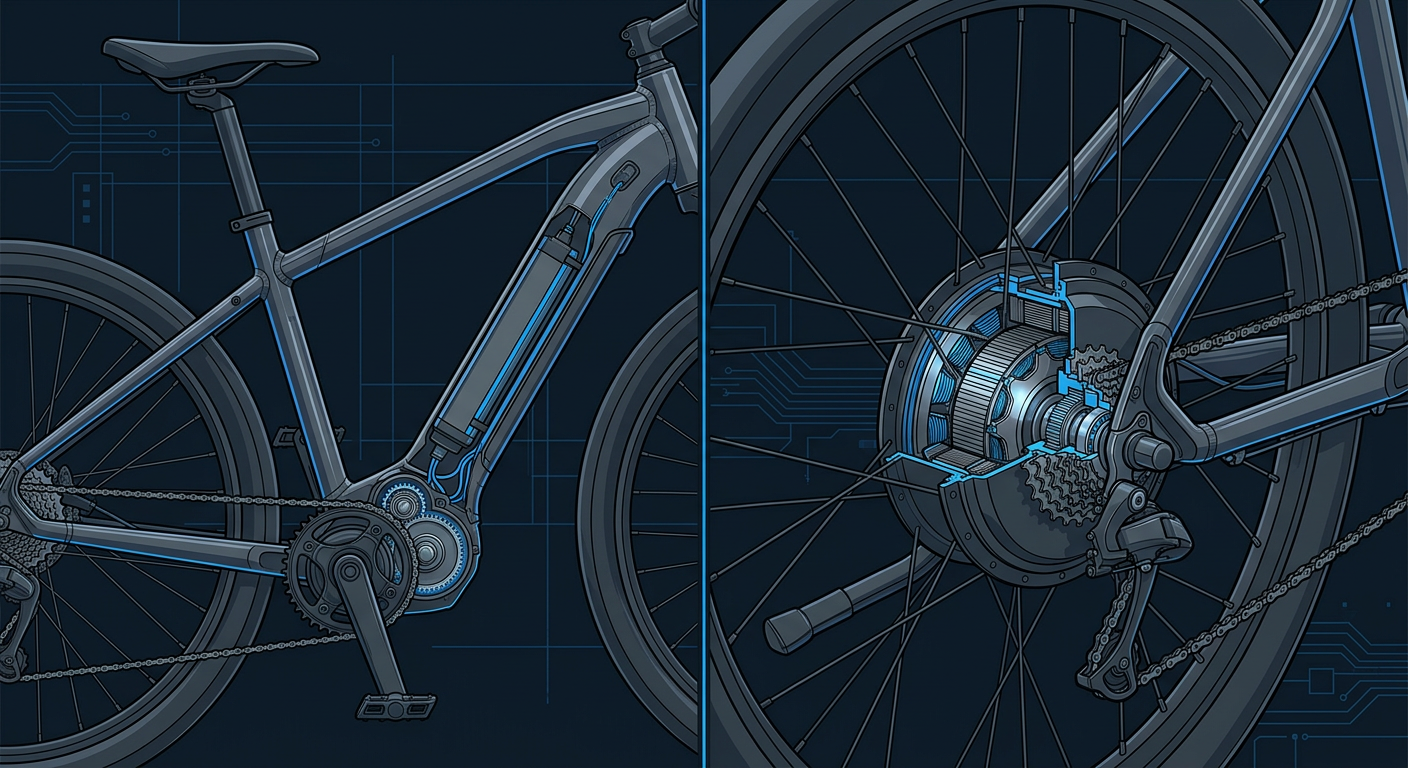
A mid-drive motor sits at the bottom bracket - right where your pedals attach. When you pedal, the motor adds its power to the chain alongside yours. That power flows through the cassette and derailleur, which means the motor benefits from your gear ratios just like your legs do.
This is the key advantage. Shift into a low gear on a steep climb, and the motor’s 85 Nm of torque gets multiplied through that gear ratio. It’s the same reason a car in first gear can crawl up a hill that would stall it in fifth. A mid-drive in a low gear can spin the rear wheel with enormous force at low speed - exactly what you need on a 20% grade.
The downside? All that motor torque runs through a bicycle chain. Chains were engineered for the 70-80 Nm that strong human legs produce, not the 85-160 Nm that modern mid-drive motors can dump through them. The result: accelerated wear on your chain, cassette, and chainring. More on that cost later.
Hub Motor: Direct Wheel Drive
A hub motor is built into the center of the wheel - usually the rear wheel. It spins the wheel directly using electromagnetic force, completely bypassing the chain and gears. Your drivetrain only handles the power from your legs, same as a regular bike.
There are two sub-types worth knowing:
- Geared hub motors use internal planetary gears to produce more torque at lower speeds. They’re lighter (typically 6-9 lbs), more efficient at low speed, and can freewheel when the motor isn’t engaged. Most quality e-bikes under $2,500 use these.
- Direct-drive hub motors have no internal gears - the motor casing IS the rotor. They’re heavier (10-14 lbs), but nearly silent and capable of regenerative braking. You’ll find these on some higher-end commuter bikes and DIY conversion kits.
Hub motors can’t use your gears for torque multiplication. On a steep hill, they have to brute-force it with raw wattage. This works fine on moderate grades up to about 10-12%, but on anything steeper, a hub motor works harder, runs hotter, and drains battery faster than a mid-drive doing the same climb.
Front hub motors exist, mostly on budget bikes under $800. They pull from the front wheel, which feels unnatural and reduces traction - especially on loose or wet surfaces. The fork wasn’t designed for lateral motor torque. Skip them unless you’re building an AWD setup on purpose (rare and niche).
Head-to-Head: The Full Comparison
This is the table you actually need. Not vague “it depends” answers - real numbers and clear winners for each category.
Mid-Drive vs Hub Motor - Complete Comparison
| Feature | Mid-Drive | Hub Motor |
|---|---|---|
| Torque output | 60-120 Nm | 40-60 Nm |
| Hill climbing | Excellent - uses gear ratios | Adequate up to ~12% grade |
| Efficiency on hills | High - motor stays in optimal RPM | Lower - bogs down on steep grades |
| Flat-ground efficiency | Good | Excellent - direct drive is efficient |
| Top speed feel | Natural, cadence-based | Strong push from rear |
| Weight distribution | Centered (near pedals) | Rear-heavy |
| Noise level | Varies - some whine under load | Near-silent (direct-drive) |
| Chain wear rate | 2-3× faster than normal | Same as regular bike |
| Annual maintenance cost | $150-300+ | $50-100 |
| Motor replacement cost | $300-800+ | $150-500 |
| Bike price (typical) | $2,000-5,000+ | $1,000-3,000 |
| Throttle availability | Rare (some models) | Common (most Class 2) |
| Regenerative braking | Not possible | Available on direct-drive hubs |
| Tire/wheel changes | Same as regular bike | Rear wheel removal is harder |
A few things jump out. Mid-drives win decisively on hills and technical terrain. Hub motors win on simplicity, cost, and everyday practicality. Neither is objectively “better.” They’re different tools for different jobs.
Mid-Drive Motors: The Deep Dive
- +Superior hill climbing - gear multiplication means effortless steep grades
- +Better weight distribution - centered mass handles more naturally
- +Higher torque output (60-120 Nm) for technical terrain
- +More natural pedal feel - power scales with your cadence
- +Easier rear wheel removal for flat repairs
- −Chews through chains and cassettes 2-3× faster
- −Higher purchase price ($800-2,000+ premium)
- −More expensive annual maintenance
- −Chain can snap under extreme torque if worn
- −Fewer throttle-equipped options
The Motors Worth Knowing
Not all mid-drives are created equal. Here are the names you’ll see on bikes worth buying:
Bosch Performance Line CX (Gen 5) - The benchmark. 85 Nm of torque, smooth power delivery, excellent cadence-sensing, and the most refined pedal feel in the business. Found on bikes from Trek, Cannondale, Gazelle, and Riese & Müller. Bosch’s ecosystem includes the Kiox display and eBike Flow app for firmware updates and ride tracking. The downside: Bosch is a closed system. Only authorized dealers can run diagnostics or do motor service.
Shimano EP8 - Bosch’s closest competitor. 85 Nm, lighter weight (2.6 kg vs Bosch’s 2.9 kg), and highly customizable assist profiles through the E-Tube app. Found on Giant, Specialized, and Santa Cruz eMTBs. Shimano’s advantage: most bike shops already work on Shimano components, so service access is easier.
Bafang M600 - The value play. 120 Nm of torque (more than Bosch or Shimano) at a significantly lower price point. Found on bikes from Aventon, Frey, and many Chinese-manufactured brands. Build quality and refinement are a step behind Bosch and Shimano, but raw power per dollar is hard to beat.
Brose Drive S Mag - 90 Nm, belt-drive compatible, and the quietest mid-drive on the market. Used by Specialized on some models and several European brands. Excellent motor, but Brose’s smaller market share means fewer service options.
You’re not just paying more for the motor. Mid-drive bikes use higher-spec drivetrains to handle the torque - beefier chains, reinforced cassettes, and stronger chainrings. That’s part of why a mid-drive bike costs more upfront AND more to maintain. A Bosch-equipped bike under $2,500 essentially doesn’t exist. Budget accordingly.
Who Should Buy a Mid-Drive
Mid-drives earn their premium for specific riders:
- Hilly commuters dealing with grades above 12% regularly
- eMTB riders who need torque multiplication on technical climbs
- Cargo haulers moving 100+ lbs of kids and gear uphill (see our cargo longtail shortlist)
- Riders who prioritize handling: centered weight distribution matters on trails and in tight urban maneuvering
If three or more of those describe you, mid-drive is worth the extra money. If none of them do, keep reading.
Hub Motors: The Deep Dive
- +Dramatically lower maintenance - chain wears at normal rate
- +Lower purchase price ($800+ less than comparable mid-drive)
- +Simple, sealed design with fewer failure points
- +Throttle option widely available (Class 2)
- +Regenerative braking possible (direct-drive hubs)
- +Quieter operation - especially direct-drive
- −Struggles on steep hills (above ~12% grade)
- −Rear-heavy weight distribution
- −Rear flat tire repair is more involved (motor wiring)
- −Can't use gear ratios - less efficient on variable terrain
- −Overheating risk on sustained long climbs
Geared vs Direct-Drive Hubs
This sub-choice matters more than most buyers realize.
Geared hub motors (Bafang 500W/750W, Shengyi) use a small internal gear reduction to trade speed for torque. They’re the dominant hub motor type on bikes under $2,500. At 40-60 Nm of torque, they handle moderate hills adequately and roll with zero drag when the motor is off. Internal gears do wear over time - typically 3,000-10,000 miles before replacement is needed - but that’s years of riding for most people.
Direct-drive hub motors (Grin All-Axle, MXUS, some Bafang models) are mechanically simpler - no internal gears to wear out. They’re heavier but can last the life of the bike if the bearings hold up. The real perk is regenerative braking: the motor acts as a generator when you slow down, feeding energy back into the battery. In practice, regen adds 5-10% extra range - not transformative, but free. The downside: noticeable drag when pedaling without assist because the magnets create resistance.
Who Should Buy a Hub Motor
Hub motors are the right call for the majority of e-bike buyers:
- Flat-terrain commuters: a hub motor on flat ground is efficient, quiet, and maintenance-free
- Budget-conscious buyers: more bike per dollar, period
- Casual riders who want simplicity over maximum performance
- Riders who want a throttle: most Class 2 throttle bikes use hub motors
- Anyone who doesn’t want to think about drivetrain maintenance
If your daily ride involves less than 500 feet of elevation gain, a hub motor will do everything you need. Save the $800+ premium and put it toward a better battery, accessories, or your first year of riding carefree. For specific model recommendations in this range, see our best e-bikes under $2,000.
The Real Cost Difference
Purchase price is just the beginning. The total cost of ownership tells a very different story than the sticker on the bike.
Year-One Costs
On a mid-drive bike ridden 2,000 miles in the first year (typical for a daily commuter), expect to replace the chain at least once, probably twice. That’s $30-100 in chains alone, plus potentially a new cassette if the first chain went too long ($40-120). Add brake pads worn faster by the extra weight, a professional tune-up with motor diagnostics, and you’re looking at $200-400 in first-year maintenance.
A hub motor bike ridden the same 2,000 miles? One chain replacement maybe (or none if you lube properly), one set of brake pads, and a basic tune-up. First-year maintenance: $75-150.
Here’s what catches mid-drive owners off guard: if you let a chain stretch past 0.75%, it reshapes your cassette teeth. Now you need a new chain AND a new cassette - $70-170 instead of $20-50. Do this twice a year and your maintenance bill rivals a car payment. A $10 chain wear checker tool and monthly checks prevent this entirely. Check our maintenance guide for the full chain care protocol.
Five-Year Total Cost of Ownership
5-Year Cost Comparison (2,000 miles/year rider)
| Cost Category | Mid-Drive Bike | Hub Motor Bike |
|---|---|---|
| Bike purchase price | $2,800 | $1,800 |
| Chains (5 years) | $250-500 | $75-150 |
| Cassettes (5 years) | $120-360 | $60-120 |
| Brake pads | $120-200 | $100-160 |
| Annual tune-ups | $500-1,000 | $400-750 |
| Motor service/replacement | $0-400 | $0-300 |
| Battery replacement (year 4-5) | $500-800 | $400-700 |
| Total 5-year cost | $4,290-6,060 | $2,835-3,980 |
The hub motor bike saves $1,000-2,000 over five years. That’s not a rounding error. It’s a second battery, a vacation, or the start of a second bike fund.
Does the mid-drive earn that premium back in performance? For the right rider - yes, absolutely. A mid-drive on steep daily hills saves you from the sweaty, battery-draining grind that a hub motor would put you through. But for flat-to-rolling terrain, you’re paying a premium for capability you won’t use.
Best Motor for Your Riding Style
Stop reading specs. Start with how you actually ride.
Motor Recommendation by Rider Type
| Rider Profile | Recommended Motor | Why |
|---|---|---|
| Flat commuter (< 5% grades) | Hub motor | Lower cost, less maintenance, throttle option |
| Hilly commuter (> 10% grades) | Mid-drive | Gear multiplication prevents motor strain |
| Weekend trail rider | Mid-drive | Torque and handling on technical terrain |
| Casual neighborhood rider | Hub motor | Simplicity and value - don't overthink it |
| Cargo hauler (kids/groceries) | Mid-drive | Torque needed for loaded climbs |
| Budget rider (under $1,500) | Hub motor | Quality mid-drives don't exist at this price |
| Speed-focused rider | Hub motor (direct-drive) | Efficient at sustained high speed on flat roads |
| Touring / long-distance | Mid-drive | Efficiency across variable terrain saves battery |
Notice a pattern? If your terrain is flat, go hub motor. If your terrain is hilly or technical, go mid-drive. Everything else is secondary to this single question: how steep is your regular ride?
Example Bikes: One of Each
To make this concrete, here are two excellent bikes at overlapping price points - one mid-drive, one hub motor.
Trek Verve+ 3 Lowstep
Best Mid-Drive CommuterAventon Soltera.2
Best Hub Motor CommuterThe price gap speaks for itself. The Trek is the better machine on paper - but “better” only matters if you need what it offers. A flat-terrain commuter on the Aventon will be just as happy as a hilly-terrain commuter on the Trek. Possibly happier, because they’ve got $1,850 still in their pocket.
The Verdict
Here it is, plainly: most first-time e-bike buyers should get a hub motor bike.
Not because hub motors are superior technology. They’re not. Mid-drives are more sophisticated, more efficient on hills, and produce a more natural ride feel on varied terrain. But the majority of e-bike buyers ride on flat-to-moderate terrain, value low maintenance, and shouldn’t spend $3,000+ on a first bike when $1,500 gets them 90% of the experience.
Hub motors are the better value for 80% of commuters. Period.
Buy a mid-drive if:
- You live somewhere with serious hills (think San Francisco, Seattle, Pittsburgh)
- You’re riding technical trails where torque and handling matter
- You’re hauling heavy cargo and kids up grades
- You’ve owned an e-bike before and know you want the upgrade
Buy a hub motor if:
- Your terrain is mostly flat to rolling
- You want the lowest total cost of ownership
- You value simplicity and low maintenance
- This is your first e-bike and you’re still figuring out what you need
- Your budget is under $2,000
If you’re still on the fence, start with a hub motor. You’ll know within six months whether your riding demands more. And if it does, you’ll upgrade with much clearer knowledge of what you actually need - instead of guessing based on forum opinions from riders with completely different terrain.
Ready to start shopping? Our complete first e-bike buying guide walks through everything from battery sizing to which e-bike class fits your commute.