
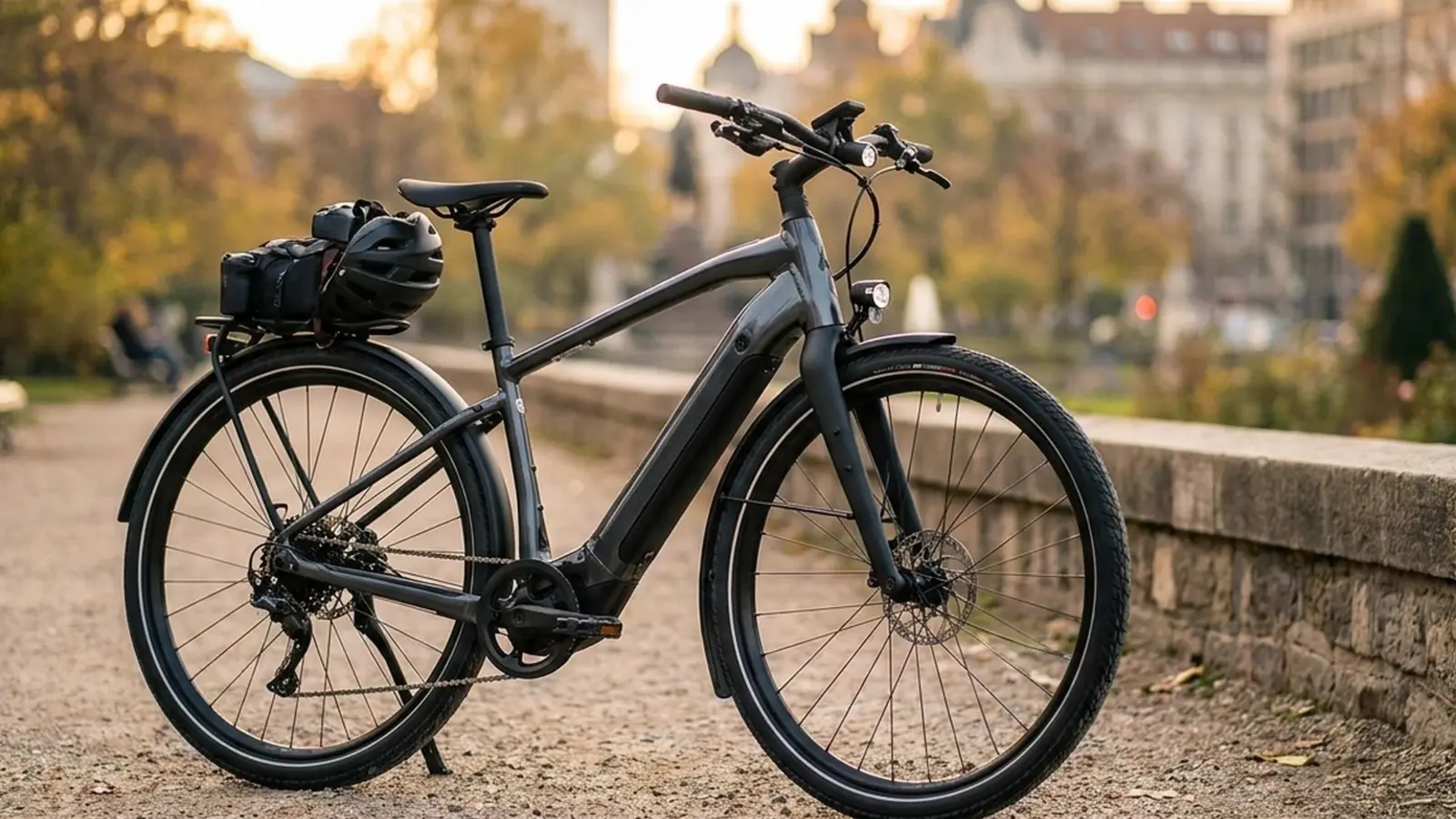
For most first-time buyers, a rear hub motor e-bike in the $1,500–2,000 range hits the sweet spot of quality, reliability, and value. Get a Class 3 if you’ll commute (28 mph pedal assist), Class 1 or 2 for casual riding. Budget at least $150 for a helmet, lock, and lights on day one. Don’t buy anything without a UL 2849 certification sticker.
What Kind of Rider Are You?
Before you even look at a spec sheet, answer one question: what are you actually going to use this bike for? Your answer determines the motor type, battery size, tire width, and frame style that make sense. Buyers who skip this step end up with a bike that’s wrong for their life, not wrong in general.
The Daily Commuter
You’re replacing car trips. You need reliability above everything, plus fenders, lights, a rack, and enough range to make the round trip without stressing. Speed matters because you’re merging with traffic. You want a Class 3 bike with at least 500 Wh of battery capacity and integrated accessories. Budget: $1,500–2,500 gets you something genuinely car-replacing.
The Weekend Explorer
You ride for fun on paved trails, greenways, and neighborhood streets. You don’t need 28 mph or a massive battery. A Class 1 or Class 2 bike with 400–500 Wh covers most recreational rides of 15–30 miles easily. This is where you’ll find the best value. Budget: $1,200–1,800 is plenty.
The Off-Road Rider
Dirt trails, fire roads, singletrack. You need fat tires, front suspension (minimum), and a motor that handles steep climbs without overheating. Mid-drive motors dominate here because they can use the bike’s gears for torque multiplication on steep grades. Budget: $2,500–5,000+ for something trail-worthy.
The Cargo Hauler
Kids, groceries, gear. Cargo e-bikes are a category unto themselves. They’re longer, heavier, and need more powerful motors and bigger batteries. If this is you, check out our cargo longtail shortlist for specific recommendations. Budget: $1,800–4,000+.
Most first-time buyers fall into the commuter or weekend explorer category. If that’s you, don’t overthink it. A solid all-around e-bike with a hub motor, 500 Wh battery, and decent components will serve both purposes well. You can always specialize with your second bike.
Motor Types Explained
The motor is the heart of an e-bike, and the type you choose affects ride feel, maintenance costs, and which terrain you can handle. There are three types worth discussing, but only two that matter for most buyers.
Mid-Drive Motors
The motor sits at the cranks (where you pedal) and drives power through the bike’s chain and gears. This means it can use your gear ratios for torque multiplication, making it excellent on steep hills. Brands like Bosch, Shimano, and Brose dominate this space.
The catch? All that motor torque runs through your chain and cassette, wearing them out 2–3x faster than a regular bike. A mid-drive e-bike chain might last 1,000–2,500 miles instead of 3,000–5,000 on a non-electric bike. That’s a real ongoing cost. Check our maintenance guide for the full breakdown on drivetrain care.
Rear Hub Motors
The motor is built into the rear wheel hub. It drives the wheel directly, bypassing the chain entirely. This means your drivetrain wears at roughly the same rate as a regular bike. Hub motors are simpler, cheaper, and require almost zero motor-specific maintenance.
The trade-off is hill performance. A hub motor can’t use your gears, so it has to muscle through steep climbs on raw wattage alone. For flat-to-moderate terrain and city riding, hub motors are fantastic. For mountain grades above 15%, they struggle.
Front Hub Motors
These exist, mostly on cheap Amazon bikes. The power delivery feels strange (pulling from the front), traction is worse, and they stress the fork in ways it wasn’t designed for. Skip them.
Mid-Drive vs Rear Hub Motor
| Feature | Mid-Drive | Rear Hub |
|---|---|---|
| Torque | 60–85 Nm typical | 40–60 Nm typical |
| Hill climbing | Excellent (uses gears) | Good on moderate grades |
| Chain wear | High (2–3x faster) | Normal (same as regular bike) |
| Weight distribution | Centered, balanced | Rear-heavy |
| Maintenance cost | Higher (drivetrain wear) | Lower |
| Price range | $2,000–5,000+ | $1,000–3,000 |
| Best for | Hills, trails, eMTB | Commuting, flat terrain, casual |
| Noise | Varies (some whine) | Generally quieter |
Our take: Unless you live in San Francisco or ride serious trails, a rear hub motor is the smarter choice for a first e-bike. Lower maintenance, lower cost, simpler to live with. Mid-drive bikes are better machines for specific use cases, but they’re overkill for most new riders.
Battery & Range: The Numbers That Actually Matter
Battery capacity is measured in watt-hours (Wh). Think of it like a gas tank measured in energy instead of gallons. More Wh = more range, all else being equal.
Here’s the simple math: Wh = Volts × Amp-hours. A 48V 13Ah battery = 624 Wh. A 36V 10Ah battery = 360 Wh. When comparing bikes, always compare Wh, not just voltage or amp-hours alone.
Real-World Range vs Marketing Claims
Every e-bike manufacturer claims their bike gets 50, 60, or even 80+ miles per charge. Those numbers are tested in the lowest assist level, on flat ground, with a 150-lb rider, at 12 mph. In other words, conditions almost nobody actually rides in.
Realistic ranges by battery size:
- 400 Wh: 20–35 miles of mixed riding
- 500 Wh: 25–45 miles of mixed riding
- 625 Wh: 35–55 miles of mixed riding
- 750 Wh: 40–65 miles of mixed riding
“Mixed riding” means a combination of assist levels, some hills, stop-and-go, and a real human weight of 150–200 lbs. Heavier riders, more hills, higher assist levels, and headwinds all reduce range. Cold weather can cut 10–20% off range because lithium-ion cells deliver less energy below 40°F.
A rough rule of thumb: plan for 15–20 Wh per mile of real-world riding. If your commute is 10 miles each way (20 miles round trip), you need at least 300–400 Wh to be comfortable. Add a 20% buffer for cold days, headwinds, and detours. That puts you at 400–500 Wh minimum for a 20-mile commute.
What Battery Size Should You Get?
For most riders, 500 Wh is the sweet spot. It covers commutes up to 20 miles round trip with margin to spare, handles recreational rides of 25–40 miles easily, and doesn’t add excessive weight. Batteries above 700 Wh add 2–4 lbs of extra weight and cost $200–400 more. Worth it if you genuinely need the range. Overkill if your rides are under 25 miles.
If you’re between two sizes, go bigger. You can always use less battery. You can’t add capacity after the fact (on most bikes).
E-Bike Classes: 1, 2, and 3
E-bike class determines your maximum assisted speed and where you’re legally allowed to ride. This isn’t optional trivia. It affects which trails accept you, whether you need registration, and how fast you can commute. For the full breakdown, see our e-bike classes guide.
E-Bike Class Comparison
| Class 1 | Class 2 | Class 3 | |
|---|---|---|---|
| Assist type | Pedal assist only | Pedal assist + throttle | Pedal assist only |
| Top assisted speed | 20 mph | 20 mph | 28 mph |
| Trail access | Most trails | Some trails | Roads & bike lanes mainly |
| License required | No (most states) | No (most states) | No (most states) |
| Best for | Trail riding, recreation | Casual riding, stop-and-go | Commuting, speed |
Which class should you pick?
- Commuters: Class 3. The difference between 20 mph and 28 mph is massive in traffic. You’ll keep up with cars on city streets and cut your commute time meaningfully. Some Class 3 bikes also include a throttle that works up to 20 mph.
- Trail riders and recreation: Class 1. Maximum trail access with no throttle to accidentally bump. Most mountain bike trail networks that allow e-bikes restrict to Class 1.
- Casual riders who want a throttle: Class 2. Nice for getting started from a stop without pedaling, for resting tired legs, or for riders with joint issues. The 20 mph cap is fine if you’re not racing anywhere.
E-bike regulations vary by state, and they’re still evolving. Some states treat all e-bikes like bicycles. Others require registration for Class 3. A few cities have banned e-bikes from certain trails or paths. Check your state and local rules before buying — a Class 3 bike on a Class 1-only trail can get you a fine and gives all e-bikers a bad reputation.
Frame & Fit
A bike that doesn’t fit is a bike that collects dust. This section matters more than most buyers realize.
Step-Through vs Step-Over
Step-through frames have a low or absent top tube. You can swing your leg over without lifting it high. These are not “women’s bikes.” They’re practical for anyone who wears work clothes, carries cargo, has limited flexibility, or just wants to get on and off easily. Most urban commuter e-bikes have moved to step-through designs for good reason.
Step-over frames (traditional diamond frame) are stiffer and lighter at the same price point. If you’re riding aggressively, doing trails, or prioritize stiffness, step-over makes sense.
Our recommendation: For commuting and city riding, step-through is the better default choice. The convenience is real and the stiffness difference is negligible at e-bike speeds and weights.
Sizing
Most e-bike brands offer 2–3 frame sizes (S, M, L) rather than the granular sizing of traditional bikes. This makes fit less precise but also simpler. General guidelines:
- 5’2”–5’6”: Small
- 5’6”–5’10”: Medium
- 5’10”–6’2”: Large
- 6’2”+: XL (if available)
These are rough starting points. Standover height matters most: you should be able to straddle the top tube with both feet flat and at least 1–2 inches of clearance. Seat height is adjustable. Handlebar reach can be tweaked with stem length. But frame size is permanent.
Buying online without knowing your inseam measurement. Measure your inseam (barefoot, book pressed to crotch, measure floor to book top). Compare to the manufacturer’s standover height spec. If it’s close, size down — you can always raise a seat, but you can’t shrink a frame. If possible, test ride at a local dealer even if you plan to buy online.
Test Rides
If there’s a local e-bike dealer or demo event near you, ride before you buy. Pay attention to these things during a test ride:
- Can you reach the ground comfortably at stops?
- Does the handlebar width feel natural?
- How does the motor engage? Smooth ramp-up or lurchy?
- Are the brakes strong enough to stop the bike confidently from full speed?
- Does the assist feel natural or does it surge?
Even 10 minutes on a bike tells you more than any spec sheet. If you can’t test ride the exact model, riding any e-bike gives you a baseline for what pedal assist feels like.
Budget Tiers: What You Get at Every Price
Let’s be direct about what your money buys. Cheaper isn’t always worse, and expensive doesn’t guarantee quality. But there are clear thresholds where component quality jumps.
E-Bike Budget Tiers
| Price Range | What You Get | What You Sacrifice | Best For |
|---|---|---|---|
| $800–1,200 | Basic hub motor, 360–400 Wh battery, mechanical disc brakes, basic components | Range, component durability, ride quality, brand support | Testing whether you'll actually ride |
| $1,200–2,000 | Solid hub motor, 500+ Wh battery, hydraulic disc brakes, decent drivetrain, warranty support | Premium motor brands (Bosch, Shimano), carbon parts, advanced suspension | Most first-time buyers — best value tier |
| $2,000–3,500 | Name-brand motors, 500–750 Wh batteries, quality suspension (if applicable), good components throughout | Top-tier everything | Serious commuters, light trail riders |
| $3,500+ | Premium everything — Bosch/Shimano motors, integrated batteries, carbon frames, top-spec components | Very little | Enthusiasts, eMTB riders, daily high-mileage commuters |
The sweet spot for most first-time buyers is $1,500–2,000. At this price, you get hydraulic disc brakes (non-negotiable for e-bike speeds and weight), a battery large enough for real-world riding, a motor with enough torque to handle moderate hills, and a brand that will actually answer the phone when something breaks.
Below $1,200, you’re making real compromises on safety-critical components like brakes and battery quality. Above $2,500, you’re paying for performance most new riders won’t fully appreciate until their second or third bike.
Brands that deliver strong value in the $1,200–2,000 range: Lectric, Rad Power Bikes, Aventon, Ride1Up, and Velotric. All sell direct-to-consumer online, which is how they keep prices competitive. For a curated list, check our best e-bikes under $2,000 guide.
Where to Buy: Online vs Local Dealer
This decision is bigger than it seems. It affects your warranty experience, your ability to get repairs, and how quickly you’re actually riding.
- +Lower prices (no dealer markup) — save $200–800 on comparable specs
- +Wider selection of brands and models
- +Convenient home delivery
- +Easy price comparison and review research
- +Strong return policies from major brands (30–60 day trials)
- −No test ride before purchase
- −Assembly required (30–90 minutes, or pay a local shop $50–100)
- −Warranty repairs may require shipping the bike or finding a local partner shop
- −No in-person relationship for quick adjustments and advice
- −Quality of assembly depends on you (or your local shop)
- +Test ride before buying
- +Professional assembly and initial setup
- +Local warranty support and repairs
- +Expert fitting and accessory advice
- +Ongoing relationship for maintenance
- −Higher prices (20–40% markup is common)
- −Smaller model selection
- −May push brands they carry, not what's best for you
- −Limited to what's in stock
Our recommendation: For your first e-bike, buying from a reputable online direct-to-consumer brand (Lectric, Rad Power, Aventon, Ride1Up) gives you the best value. But here’s the key: find a local bike shop willing to assemble and service it. Many shops will assemble an online-purchased e-bike for $50–100, and that professional assembly is worth every dollar. Ask before you buy whether local shops in your area service the brand you’re considering.
If you have a solid local e-bike dealer with brands you like, the premium is worth it for the test ride and ongoing service relationship. Just don’t buy from Amazon marketplace sellers or no-name brands with no local service network.
Day-One Accessories
Don’t ride your new e-bike without these. Some are safety-critical, others just make the experience dramatically better from ride one.
A regular bike helmet works, but a MIPS-equipped helmet adds rotational impact protection. At e-bike speeds (20–28 mph), this matters. Brands: Giro, Bell, Smith, POC.
EssentialKryptonite New York or Abus Granit series. A cheap lock on a $1,500+ bike is a bad investment. Use the U-lock on the frame and rear wheel, cable through the front wheel.
EssentialUSB-rechargeable, 500+ lumens front, solid + flash rear. Even for daytime riding. Many e-bikes include integrated lights — check before buying extra.
EssentialSpare tube, tire levers, mini pump or CO2 inflator. E-bike tires are heavier and harder to change. Practice at home before you need to do it trailside.
EssentialIf commuting, a rack and waterproof pannier replaces a backpack. Your back stays dry. Your stuff stays organized. Check rack compatibility before buying.
RecommendedQuad Lock or similar secure mount. Use your phone for navigation instead of buying a separate GPS. Make sure it's vibration-dampened to protect your camera module.
RecommendedFull-coverage fenders keep road spray off you and the motor. Essential for commuting in any climate with rain. Many e-bikes include them — check before buying.
RecommendedSmall bar-end mirror or helmet-mounted mirror. Seeing traffic behind you without turning your head is a safety upgrade most riders don't realize they need until they try one.
Nice to HavePlan to spend $150–300 on accessories on top of the bike price. A $1,600 bike with no lock, no lights, and no helmet isn’t rideable. Factor this into your total budget from the start. The essentials above run about $150–250 total.
Red Flags: What to Avoid
The e-bike market has exploded, and not every brand selling bikes deserves your money. Here’s how to spot the ones that don’t.
No UL 2849 certification. This is the safety standard for e-bike electrical systems. It covers battery safety, charging, and fire resistance. After multiple e-bike battery fires made headlines, UL certification became the minimum bar for a responsible brand. If a manufacturer can’t show you a UL 2849 sticker, don’t bring their battery into your home.
Range claims over 80 miles on a 500 Wh battery. That’s physically implausible for real-world riding. The math doesn’t work unless you’re pedaling downhill at 8 mph in eco mode. Wildly inflated range claims signal a brand that’s comfortable lying to you.
No-name batteries with no cell origin info. Quality e-bikes use cells from Samsung, LG, or Panasonic/Sanyo. Budget brands that won’t tell you who made their cells are probably using cheap, inconsistent cells with higher fire and failure risk.
No warranty or a warranty with impossible claim processes. A one-year warranty is the bare minimum. Good brands offer two years on the bike and one to two years on the battery. If the warranty requires shipping the entire bike back at your expense, it’s effectively no warranty at all.
Amazon marketplace sellers with no independent website. If the brand doesn’t exist outside of Amazon, who handles warranty claims in two years? Where do you get replacement parts? A real brand has a real website, real customer service, and a parts supply chain.
Other Things Worth Skipping
- Suspension seatposts on road/commuter bikes. They add weight and bob under pedaling. If your ride is rough enough to need suspension, get a bike with a proper front fork.
- “1,000W” motors on bikes advertised as street-legal. In most states, e-bikes are capped at 750W nominal. Sellers advertising more are either mislabeling or selling something that’s legally a moped requiring registration and insurance.
- Full-suspension under $2,500. Cheap rear suspension adds weight, complexity, and maintenance without actually working well. A quality hardtail at $2,000 outperforms a cheap full-suspension at $2,000 every time.
Your Pre-Purchase Checklist
Before you click “buy,” run through this list:
- Rider type identified: Commuter, recreation, off-road, or cargo?
- Class chosen: Class 1, 2, or 3 based on your use case and local laws?
- Motor type decided: Hub for simplicity, mid-drive for hills and trails?
- Battery sized: Enough Wh for your typical ride plus a 20% buffer?
- Frame style picked: Step-through or step-over? Size checked against your inseam?
- Budget set: Bike price PLUS $150–300 for essential accessories?
- Brand researched: UL 2849 certified? Real warranty? Accessible customer service?
- Local service identified: Shop that will assemble and maintain the bike?
- Test ridden (if possible): At a dealer, demo event, or friend’s bike?
If you can check all nine boxes, you’re ready to buy. If you can’t, slow down and fill in the gaps. A week of extra research is better than a year of regret with the wrong bike.
For model-specific recommendations, see our best e-bikes under $2,000 guide and Class 3 commuter shortlist.