
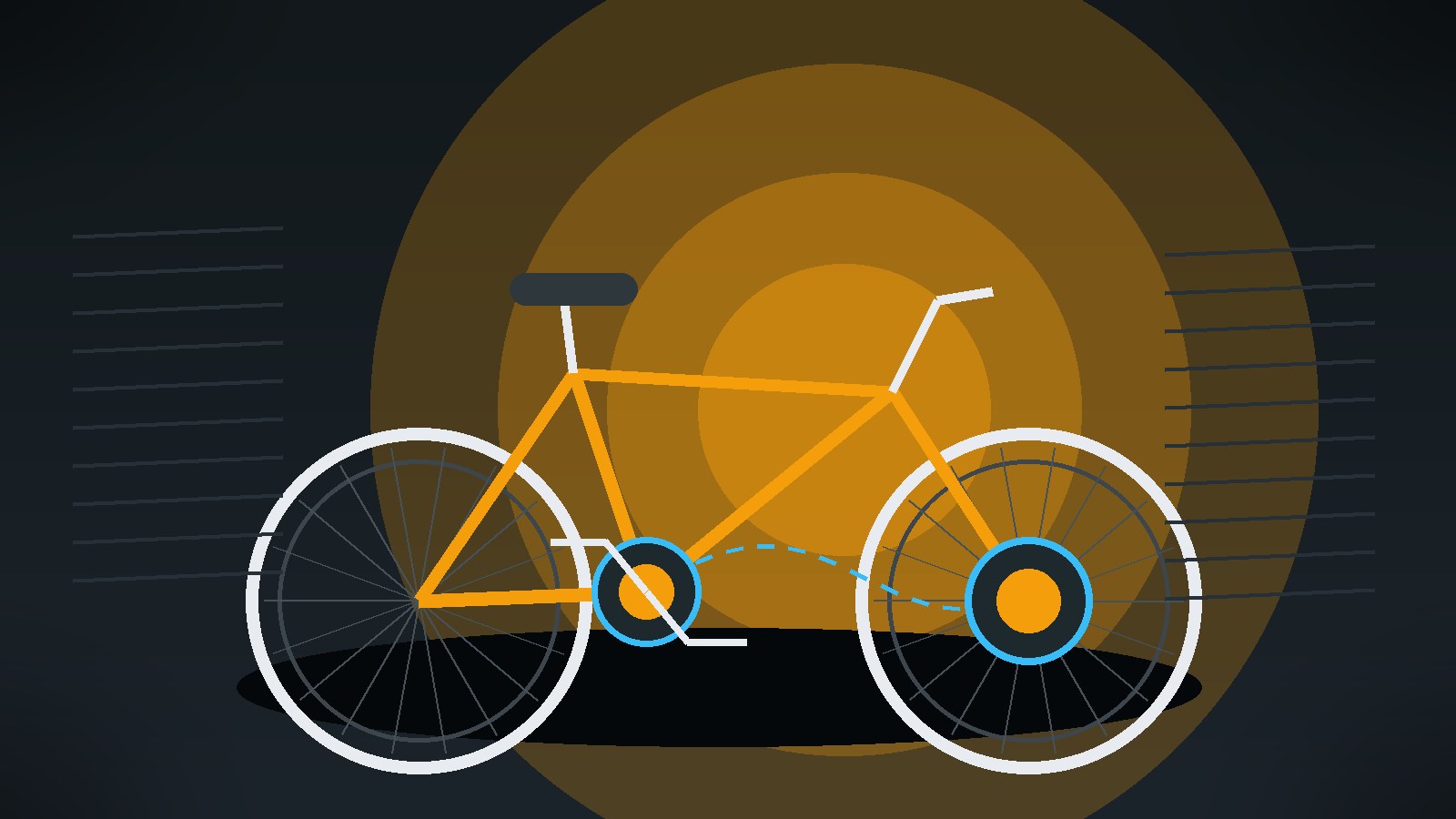
For more than a century, every bicycle has shared one stubborn piece of hardware: a chain or belt connecting the cranks to the rear wheel. Even the most futuristic e-bike on the market today still leans on that same mechanical link, just with a battery bolted on. A new drive system in development wants to throw that whole idea out, replacing the physical connection between your legs and the rear wheel with electronics, sensors, and a generator at the cranks.
It sounds like science fiction. It is also, technically, already here. The concept is called pedal-by-wire, and if it actually delivers on its promises, it could reshape how e-bikes are designed, ridden, and serviced. The skeptics have plenty of reasons to roll their eyes, and they are not wrong to do so. But the underlying engineering is sound enough that it deserves a serious look rather than a dismissive one.
This guide explains what pedal-by-wire actually is, how it differs from a traditional e-bike drivetrain, where the real benefits live, and where the system is going to struggle. If you are trying to decide whether this is the future of cycling or a clever solution looking for a problem, by the end you will have a clear answer.
What pedal-by-wire actually means
In a normal e-bike, your pedaling does two things. First, it drives the rear wheel through a chain or belt and a set of gears. Second, on bikes with a torque sensor, it tells the motor how much assistance to add. The mechanical and the electrical work together. Take away the chain and the bike does not move under your power.
Pedal-by-wire breaks that link. Your pedals turn a small generator at the bottom bracket. That generator produces electricity. The electricity flows to a motor at the rear wheel, which actually drives the bike. There is no chain, no derailleur, no cassette, no belt. The cranks spin a generator, the generator feeds the motor, and the motor turns the wheel.
It is conceptually similar to a series hybrid car. In a Chevy Volt or a diesel-electric locomotive, the engine never directly drives the wheels. It just makes electricity for the electric motor that does the actual work. Pedal-by-wire applies the same idea to a bicycle, with your legs playing the role of the engine.
The first pedal-by-wire systems coming out of development show a fairly clean layout: a sealed crank unit with built-in generator, a rear hub motor, a battery, and a controller that ties them all together. From the rider’s seat, the pedals still turn, the bike still moves, and pedaling harder still makes you go faster. What is different is how that input gets converted into forward motion.
Why anyone would build this
Killing the chain is not a small change. So before you can even start a conversation about whether riders want this, you have to ask why an engineer would bother. The answers are more practical than they might first appear.
Infinite, instant gear ratios
A pedal-by-wire system has no gears in the traditional sense. The relationship between your pedaling speed and your wheel speed is set entirely by software. That means you can have what feels like a perfectly tuned gear ratio at every speed and grade, automatically, without ever shifting.
Climbing a steep hill? The system lets you spin the cranks at a comfortable cadence while it sends more torque to the rear wheel. Cruising on flat ground at high speed? Same comfortable cadence, but now the rear wheel spins faster relative to the cranks. There is no clunky shift point, no chainline angle, no skipped gear. It is just smooth.
Riders coming off internally geared hubs, which already feel cleaner than derailleur drivetrains, will recognize the appeal. Pedal-by-wire takes that idea further. There is no fixed number of gears at all.
A radically simpler frame
Cyclists who have built or repaired a bike know how much chassis design is dictated by the chain. Chainstay length, bottom bracket height, derailleur hanger geometry, dropout spacing: all of it is constrained by the need to route a moving chain in a straight line from the cranks to the rear cog. Take the chain out and the frame can be almost any shape you want.
Bike designers have already started exploring what this enables: cleaner cargo bike layouts, frames that fold in unusual ways, fully enclosed drivetrains that do not get covered in road grime. Without a chain, the rear suspension on a full-suspension e-bike no longer fights against chain growth. Step-through frames with deeper steps. Mid-step utility bikes with cargo decks where a chainstay used to live.
Drastically less maintenance
The chain is the dirtiest, most maintenance-heavy part of a bicycle. It stretches, it rusts, it picks up grit, and it grinds its way through cassettes and chainrings. A typical e-bike chain lasts maybe 1,500 to 3,000 miles before it needs replacing, and a worn chain destroys the cassette right alongside it.
A pedal-by-wire system, in theory, eliminates all of that. The generator and motor are sealed units. There is no cassette to wear, no derailleur to bend, no chain to lube. For commuters who put thousands of miles on a bike per year and keep it parked outside, the maintenance savings could be substantial.
The catch: efficiency
There is no free lunch in physics, and pedal-by-wire pays its lunch bill in efficiency. Every energy conversion has losses. A modern bicycle chain, properly lubricated, transmits roughly 96 to 98 percent of your pedaling power to the rear wheel. It is one of the most efficient mechanical systems humans have ever built.
A pedal-by-wire system has to convert your mechanical pedaling into electricity at the generator (call that 90 to 95 percent efficient on a good day), then convert that electricity back into motion at the rear motor (another 85 to 92 percent). Multiply those losses together and you are looking at a real-world efficiency in the low 80s at best. That is a meaningful gap.
For a casual rider on an e-bike with assistance, this may not matter much. The motor is making up most of the difference anyway, and the lost watts come out of the battery rather than your legs. For a serious cyclist on an analog road bike, that level of efficiency loss would be unacceptable. Pedal-by-wire is not coming for the road race scene any time soon.
There is a more interesting question about whether the efficiency loss can be partially recovered. Pedal-by-wire systems are inherently regen-capable. Every coast, every brake application, every downhill is a chance to dump energy back into the battery. A traditional chain drive cannot do that without bolting on extra hardware.
How it compares to what you can buy today
To put pedal-by-wire in context, here is how the major drive system types stack up on the things riders actually care about.
E-bike drivetrain types compared
data| System | Drivetrain efficiency | Maintenance | Shift feel | Regen capable | Cost |
|---|---|---|---|---|---|
| Chain + derailleur | 96 to 98% | High, frequent | Manual, can clunk | No | Lowest |
| Belt + internally geared hub | 92 to 95% | Low, predictable | Manual, smooth | No | Higher |
| Mid-drive with chain | 94 to 96% | High under power | Manual, sensitive | No | Mid to high |
| Pedal-by-wire (series) | 78 to 85% | Very low projected | Automatic, seamless | Yes | High (early) |
The headline takeaway: pedal-by-wire trades efficiency for everything else. Whether that is a good trade depends entirely on the kind of riding you do.
Who pedal-by-wire actually makes sense for
This is where the marketing story and the engineering reality have to meet. Pedal-by-wire is genuinely interesting for some riders and almost pointless for others.
Should you care about pedal-by-wire?
quick pick| If you… | Pick | Why |
|---|---|---|
| you ride a daily commuter in a wet, gritty climate | Strong fit | Sealed drivetrain, no chain to clean, automatic shifting in stop-and-go traffic. Efficiency loss is offset by motor assist anyway. |
| you ride a cargo or family hauler | Strong fit | No chain growth issues, simpler frame design, predictable maintenance with kids on board. |
| you are a road or gravel cyclist who values pedal feel | Skip it | The efficiency loss is real and you will feel it. Stick with a chain. |
| you ride enduro or technical trail | Wait and see | The geometry freedom is interesting but motor weight at the rear hub is a big handling penalty. First-gen systems will not be tuned for this. |
| you live in a hilly city and hate shifting | Strong fit | Automatic, infinite ratio shifting in city traffic is the killer feature. Regen on descents is a real bonus. |
The honest read is that pedal-by-wire is a city and utility bike technology first. That is also where most e-bike sales already are. If a system works as advertised in a commuter context and prices come down, it could become the default in five to ten years for the urban segment, while road and trail bikes keep their chains.
What could go wrong
A few specific risks are worth taking seriously, beyond the efficiency conversation.
Repairability. A chain is universal. A pedal-by-wire generator unit is not. If a small startup builds a bike around their own proprietary system and then folds, owners are stuck with paperweight e-bikes. This has already happened to riders who bought from companies like VanMoof. Any rider buying into a pedal-by-wire system early should look very carefully at parts availability and the company’s track record.
Regulatory classification. US e-bike classes (1, 2, 3) all assume a pedal-assist or throttle paradigm where pedaling provides direct mechanical input plus optional motor help. A pure pedal-by-wire system blurs that line: technically, your pedaling never moves the wheel directly, even when the motor is “off.” Different states and countries are going to interpret this differently, and some might treat pedal-by-wire as a pure motor vehicle. Riders should expect some legal uncertainty for the first few years.
Software risk. Once your drivetrain is electronic, it is software. Software has bugs. Firmware updates can change the feel of the bike overnight. Some of these systems will require apps, accounts, and cloud connectivity. None of that is inherent to the technology, but it is the direction most of the industry has been going. If you are someone who likes a bike you can fix with hex keys and patience, the software-first nature of pedal-by-wire is a downside.
Where this is headed
The first generation of consumer pedal-by-wire bikes is going to be expensive, niche, and a little weird. That is normal for any new drivetrain technology. Belt drives looked like a curiosity in the early 2000s and now ship on a meaningful percentage of premium commuter bikes. Internally geared hubs were a Dutch oddity for decades before American riders started accepting them.
The second and third generations are where things get interesting. Expect to see costs drop as generator and motor units get standardized. Expect frame designers to start building bikes that take real advantage of the chain-free layout: not just adapted standard frames, but ground-up designs that look nothing like a current e-bike.
Expect, also, a backlash from purists. There are riders who will never accept a bike where their legs do not directly turn the wheel. That is a fair preference. The chain is not going away. But for the millions of riders who want a bike that just works, holds up to weather and miles, and never needs a derailleur adjustment, pedal-by-wire might quietly become the dominant urban drivetrain by the early 2030s.
Source: Electrek, April 23, 2026.
The Electrek piece that put this technology on a lot of riders’ radars framed it as a possible revolution. Revolution is a strong word. Quiet evolution is more accurate, and probably more useful. Either way, the chain finally has a credible challenger for the first time since John Kemp Starley sketched a Rover safety bicycle.