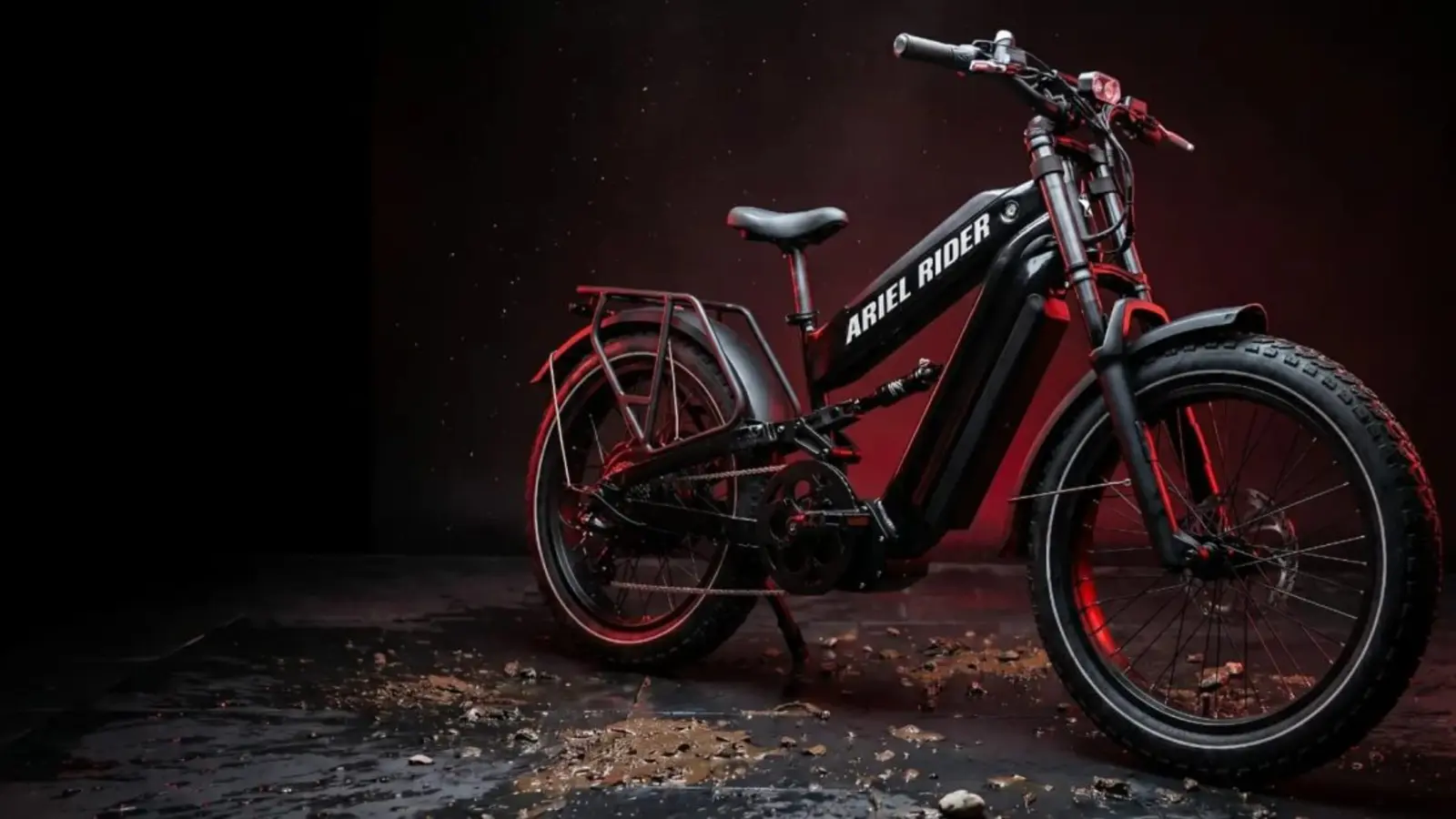
Ariel Rider has opened pre-orders for the MUDD 72V, and the company is not pretending it is a bicycle. Electrek reports that Ariel Rider markets it as a high-performance “PPB,” short for private property bike, built for off-road and closed-course use. The reported numbers explain why: a 72V system with a 3,500W-rated oil-cooled rear hub motor peaking at 8,000W, a claimed top speed exceeding 65 mph, and up to 330 Nm of claimed torque.
That is motorcycle-adjacent performance in a package that still has pedals. For buyers, the most important thing about this launch is not the spec sheet. It is the category. The MUDD 72V is not a Class 1, 2, or 3 electric bicycle, and Ariel Rider itself presents it as something for private land rather than public streets or bike paths.
Since our original coverage, IEEE Spectrum has published a detailed report by Willie D. Jones on exactly where machines like the MUDD land legally, using New York and California as its main case studies. It turns out “not an e-bike” means very different things depending on which state you live in, and that reporting sharpens the buying picture considerably.
Why This Is Not a Class 1, 2, or 3 E-Bike
Most U.S. states have adopted a three-class system that caps legal e-bikes at 750W of motor power and either 20 mph (Class 1 and 2) or 28 mph (Class 3) of assisted speed. Our e-bike classes guide walks through the details, but the short version is that the class system is what lets an e-bike be treated like a bicycle: bike lanes, bike paths, no registration, no motorcycle license.
Two caveats matter more now than they did at launch. First, the class system is not universal. Per a 2026 state-by-state survey cited in IEEE Spectrum’s report, 14 states have not adopted it at all. Second, the states that did adopt it do not all define it the same way. IEEE Spectrum notes that under New York’s vehicle and traffic law, Class 3 is a pedal-assist category capped at 25 mph and permitted only in cities of a million or more people, which in practice means New York City alone. That is a different Class 3 than the 28 mph version most states use.
The MUDD 72V, as reported, clears every version of these limits by a wide margin. A 3,500W-rated motor with an 8,000W peak and a 65+ mph top speed is not close to any class definition, and pedals with a cadence sensor do not change that. What happens next legally depends entirely on your state, which is where the IEEE Spectrum reporting earns its keep.
Credit where due: Ariel Rider is being upfront about the category. Per Electrek, the company explicitly positions the MUDD 72V for off-road and private-property use rather than dressing it up as a street-legal e-bike. IEEE Spectrum goes further, reporting that Ariel Rider’s terms of service state the bike is not an e-bike, is not certified for on-road use, and is sold only for private land or closed courses. That honesty is better for buyers than the wink-and-nod marketing that has gotten some high-power “e-bikes” and their riders into trouble.
What New York’s Law Does With a Machine Like This
IEEE Spectrum’s report is built around a striking finding: in New York, the MUDD does not just fall outside the e-bike classes, it falls outside every category the state has.
Here is the chain, per IEEE Spectrum’s reading of New York law. Anything exceeding the state’s e-bike speed or power thresholds is reclassified by default as a moped or motorcycle, which triggers registration, a license, and insurance. New York has leaned on that fallback for years. But registering the MUDD as a motorcycle is not actually an option, because Ariel Rider’s terms of service, as reported by IEEE Spectrum, offer no DMV title path and do not certify the machine for on-road use. IEEE Spectrum asked Ariel Rider how it squares those terms with marketing the MUDD as a “power bike” and got no response.
Then comes the gap that makes the story. New York’s ATV statute, Vehicle and Traffic Law section 2407, requires liability insurance the moment an all-terrain vehicle leaves land its owner owns, and mandates DMV registration even on private property. But per IEEE Spectrum, that statute is written around New York’s ATV definition, which typically means three or more wheels. A two-wheeled machine like the MUDD does not trigger it. The result, in IEEE Spectrum’s words, is a machine capable of highway speeds that is not a legal e-bike, not a registrable motorcycle, and not an ATV under state law. A New York owner riding only on land they own faces no state mandate to register or insure it today.
New York City adds one more layer that matters if you want to buy locally. IEEE Spectrum reports that the city’s fire code requires UL-certified batteries and electrical systems for any e-bike sold in the five boroughs, and that this certification rule is what barred some of Ariel Rider’s older models from sale there in 2024, per a company compliance notice cited in the report. That system polices fire risk rather than vehicle type, so it is a separate hurdle from the classification question entirely.
The enforcement climate around the category is also tightening. IEEE Spectrum notes that a New York state senator has introduced a bill, S8909, that would let peace officers seize Class 3 e-bikes operated outside New York City, on top of an existing “Ghost Car Task Force” already sweeping up unregistered mopeds and out-of-class machines. None of that targets a MUDD parked on private land, but it tells you which way the wind is blowing for anything that looks like this on a public street.
California Took the Opposite Approach
If New York’s problem is having no category for the MUDD, California’s answer was to build one. IEEE Spectrum reports that SB 586, signed in October 2025 and effective January 1, 2026, defines “off-highway electric motorcycles” in state law and requires a DMV-issued Green Sticker for them, per a California State Parks OHV bulletin. Separately, the U.S. Forest Service has reminded riders that Sur-Ron, Talaria, Segway, and similar electric motorcycles must register like gas-powered OHVs to use public trails.
For a buyer, that is a meaningfully different situation than New York’s. As IEEE Spectrum puts it, the California model gives every off-road machine a lane regardless of wheel count. The report does not say whether the MUDD 72V specifically qualifies for Green Sticker registration, so if riding public OHV areas in California is your plan, confirming that with the DMV or the seller before you pay a deposit is the single most important piece of homework on your list.
California is also where the definition fight is happening. IEEE Spectrum reports that PeopleForBikes, the bicycle industry’s national trade group, backs a 2026 California bill (SB 1167) to tighten the legal definition of an electric bicycle. The group’s policy counsel argues it would close the gaps that let fast motorized vehicles proliferate under the e-bike label while shielding legitimate low-speed bikes, and the same group opposes blanket e-bike registration schemes. The direction of travel is clear: a harder line around what counts as an e-bike, with machines like the MUDD explicitly on the other side of it.
Why One State’s Rules Do Not Generalize
The New York situation makes headlines, but it would be a mistake to read it as the national rule. IEEE Spectrum sorts states into three rough camps, and the MUDD’s practical legality shifts with each one.
Some states have a dedicated off-highway vehicle framework, California now being the clearest example, where a machine like this gets a defined registration path for off-road use. Other states, per the report, treat anything too powerful for e-bike rules as a motorized off-road vehicle unless it meets full on-road motorcycle requirements, meaning a VIN, a title, and registration; some manufacturers build electric motorcycles to that standard specifically to avoid the gray zone the MUDD occupies. And then there are the states that have not addressed the gap at all, including the 14 without a three-class system. Within that last group the spread is wide: IEEE Spectrum notes Alaska treats e-bikes as motorcycles outright, while New Jersey eliminated its class system earlier this year and folded every e-bike into a single “motorized bicycle” category requiring registration and insurance.
Our takeaway from that patchwork: “where can I ride it, and do I have to register or insure it” has no national answer for the MUDD 72V. It depends on your state’s vehicle code, your land manager’s rules if you ride anywhere you do not own, and in some cities a separate battery certification regime on top. New York’s two-wheel gap is real, per IEEE Spectrum, but it is a description of one state’s unfinished law, not a green light anywhere else. Our state-by-state e-bike law guide is a starting point, but for a machine this far outside e-bike definitions you need the off-highway vehicle rules, not just the e-bike rules.
What the Reported Specs Actually Imply
Taking Electrek’s reported figures at face value, here is what stands out from a buyer’s perspective:
- Battery: 72V 39Ah, 2,808 Wh. That is roughly four to five times the capacity of a typical commuter e-bike battery. It is the main reason for the claimed 80 to 120 mile range, and also a reason to think about charging logistics and storage. A pack this large deserves the same respect you would give a small motorcycle battery. And if you are in New York City, remember the fire code angle above: UL certification status matters for whether it can even be sold there.
- Range: a claimed 80 to 120 miles. As always, the spread depends on conditions and mode, and full-throttle riding at high speed will land well below the top of that range. Treat the lower bound as the planning number until real-world tests exist.
- Weight: 95 lb, with a 400 lb max payload. At 95 pounds, this is not something you carry up stairs or lift onto a standard bike rack. Transport to your riding spot likely means a truck bed, a trailer, or a heavy-duty hitch carrier. That matters double for a machine sold for private land and closed courses, because trailering it there is part of the ownership cost.
- Chassis: linkage-driven rear suspension, a 100 mm thru-axle suspension fork, and four-piston hydraulic brakes with 220 mm rotors front and rear. Those brake specs are appropriate for the claimed speed, and the suspension layout reads more moto than mountain bike. The 24x4.0 inch fat tires point the same direction.
- Controls: a 95A sine-wave controller, Eco, Sport, and Boost modes, six assist levels, plus a half-twist throttle alongside the pedals. The pedal drivetrain uses a cadence sensor, so expect the pedals to function more as a backup than as a precision assist system. Note that the pedals carry no legal weight here: as the New York analysis above shows, power and speed put the MUDD outside e-bike definitions regardless.
One honest caveat: a 100 mm travel fork is modest by dirt bike standards. Whether the suspension matches the 65 mph claim in real terrain is exactly the kind of question that needs independent testing to answer, and none exists yet.
Price and the Pre-Order Question
Electrek reports an introductory pre-order price of $2,799 against a listed MSRP of $3,099. That undercuts most purpose-built electric dirt bikes, which is clearly the pitch: near e-moto performance at fat-tire e-bike money.
Before putting money down on any pre-order, and this one specifically, work through this list:
- Confirm you actually have somewhere to ride it. This is still the big one, and the IEEE Spectrum reporting makes it more concrete. On land you own in New York, current state law imposes no registration or insurance mandate on a two-wheeler like this, per the report. Ride anywhere else, or live in a state with an OHV framework like California’s, and the answer changes. If you do not own or have reliable access to private land, a closed course, or an OHV area that permits this type of vehicle, the MUDD 72V has no legal home in your life.
- Know your state’s answer before you order, not after. Check whether your state has an off-highway electric motorcycle category, requires full motorcycle compliance, or has no framework at all. Remember that Ariel Rider’s terms, as reported by IEEE Spectrum, provide no DMV title path, so any plan that depends on registering it as a motorcycle is a plan the manufacturer’s own paperwork does not support.
- Treat claimed specs as claims. Top speed, torque, and range figures come from the manufacturer via Electrek’s reporting. No independent review of this bike exists yet. If a spec is the reason you are buying, waiting for third-party testing costs you nothing but time.
- Understand the pre-order terms. Deposit refundability, estimated ship dates, and what happens if specs change between announcement and delivery all matter more on a pre-order than on an in-stock purchase. Read the terms of service closely; per IEEE Spectrum they also contain the private-land-only and no-title-path language that defines what you are buying. Get everything in writing before you pay.
- Plan for transport and storage. A 95 lb machine with a 2,808 Wh battery needs a real transport plan and a sensible charging and storage setup. Factor that into the budget alongside gear.
- Check insurance and liability. Homeowner policies and standard bike insurance often exclude vehicles in this power range, and as the IEEE Spectrum report notes, the absence of an insurance mandate does not remove personal liability if someone gets hurt. Worth a call before delivery, not after.
Where It Fits: Not an E-Bike, Not Quite an E-Moto
The MUDD 72V slots into the gap between the two categories we cover most, and IEEE Spectrum’s reporting confirms that the gap is a real legal space, not just a marketing one. The report frames the MUDD as part of the lightweight electric dirt bike segment that Sur-Ron’s Light Bee kicked off in 2014, with Talaria, Segway, and others following, and it treats the MUDD as a bellwether for how states will regulate the whole category. That segment is growing fast enough that regulators and the bicycle industry’s own trade group are now actively working to draw a harder line around it.
Compared with a legal Class 1, 2, or 3 e-bike, it is not a substitute at all. It cannot legally do the e-bike’s job of commuting in bike lanes and rolling on multi-use paths, and no discount price changes that. If you want one machine for errands and trails around town, a compliant e-bike remains the answer.
Compared with purpose-built electric dirt bikes, the value pitch gets more interesting. The reported price undercuts most true e-motos, and the claimed torque and speed figures are in their neighborhood. What the spec sheet cannot tell you is whether the frame, suspension, and components hold up to being ridden like a dirt bike, which is how a 65 mph machine will inevitably be ridden. Established e-motos have track records; this bike has a launch page. There is also a longevity question the legal reporting raises: states are actively rewriting these rules in 2026, so the regulatory ground under a “private property bike” may not look the same in two years.
If you have the land, the transport, clarity on your own state’s rules, and the patience to wait for independent reviews, the MUDD 72V is a genuinely interesting entry at the price. If you were hoping it could double as your street e-bike, it cannot, and both Ariel Rider’s terms of service and the reporting on them make that plain.
Sources
- Ariel Rider launches outrageous new MUDD 72V bike with 65 MPH top speed (Electrek)
- Will “E-Moto” Two-Wheelers Go Street Legal? (IEEE Spectrum, Willie D. Jones, August 5, 2026)